Is Plywood Waterproof? Can It Get Wet?
Author
Area Manager, Servicing
After Sales servicing experience in building materials, Industry experience of 9 years
Read full bio →Updated:
"Is plywood waterproof?" doesn't have one answer — because plywood isn't one material. The wood veneers that make up the layers are almost identical across grades. What actually changes from board to board, and what decides how it behaves around water, is the adhesive holding those layers together.
That one variable is why two boards that look identical on a showroom shelf can behave completely differently the first time they're near a sink, a monsoon-soaked balcony, or a leaking pipe. Here's what each grade is actually built to handle, and what "waterproof" really means once you're past the marketing language.
MR grade: not waterproof, and it was never meant to be
MR (Moisture Resistant) plywood is bonded with a urea-formaldehyde adhesive — a glue formulated to tolerate everyday humidity in the air, not direct or standing water.
Here's the mechanism worth understanding: urea-formaldehyde bonds are vulnerable to hydrolysis — a chemical reaction where water molecules gradually break down the adhesive's bond strength when they're in sustained contact with it. A bit of ambient moisture in a bedroom or a wardrobe doesn't trigger this. A spilled glass of water, wiped up quickly, doesn't either. But standing water left on the surface for hours, or a leak that goes unnoticed, will.
Once that bond starts to weaken, the layers don't fail all at once — they delaminate, meaning the thin veneer sheets start separating from each other at the edges first, then progressively further in. This is why MR-grade furniture that's taken water damage often shows a telltale swollen, flaking edge long before the center of the panel looks affected.
MR grade is built for exactly one job: furniture in rooms that stay dry. Bedroom wardrobes, study tables, living room units, and interior doors in non-wet areas are all appropriate uses. It is not a defect that MR plywood can't handle water — it was never engineered to.
BWR grade: a genuine step up, but still not fully waterproof
BWR (Boiling Water Resistant) plywood uses a stronger adhesive formulation than MR, one that's tested to tolerate a short period of exposure to boiling water without the bond failing outright.
That short-duration tolerance is the key phrase. BWR is meaningfully better suited to occasional splashes and humid conditions than MR, which is why it's a sensible choice for kitchen areas that see moisture in the air and the occasional spill, but aren't directly soaked for extended stretches. What BWR is not built for is prolonged or repeated submersion — a BWR board sitting under a slow leak for days will eventually show the same delamination pattern as MR, just on a longer timeline because the adhesive holds up longer before it gives way.
Think of BWR as the middle tier: a real upgrade in moisture tolerance, but not a license to install it anywhere water might pool or sit.
BWP grade: engineered to actually be waterproof
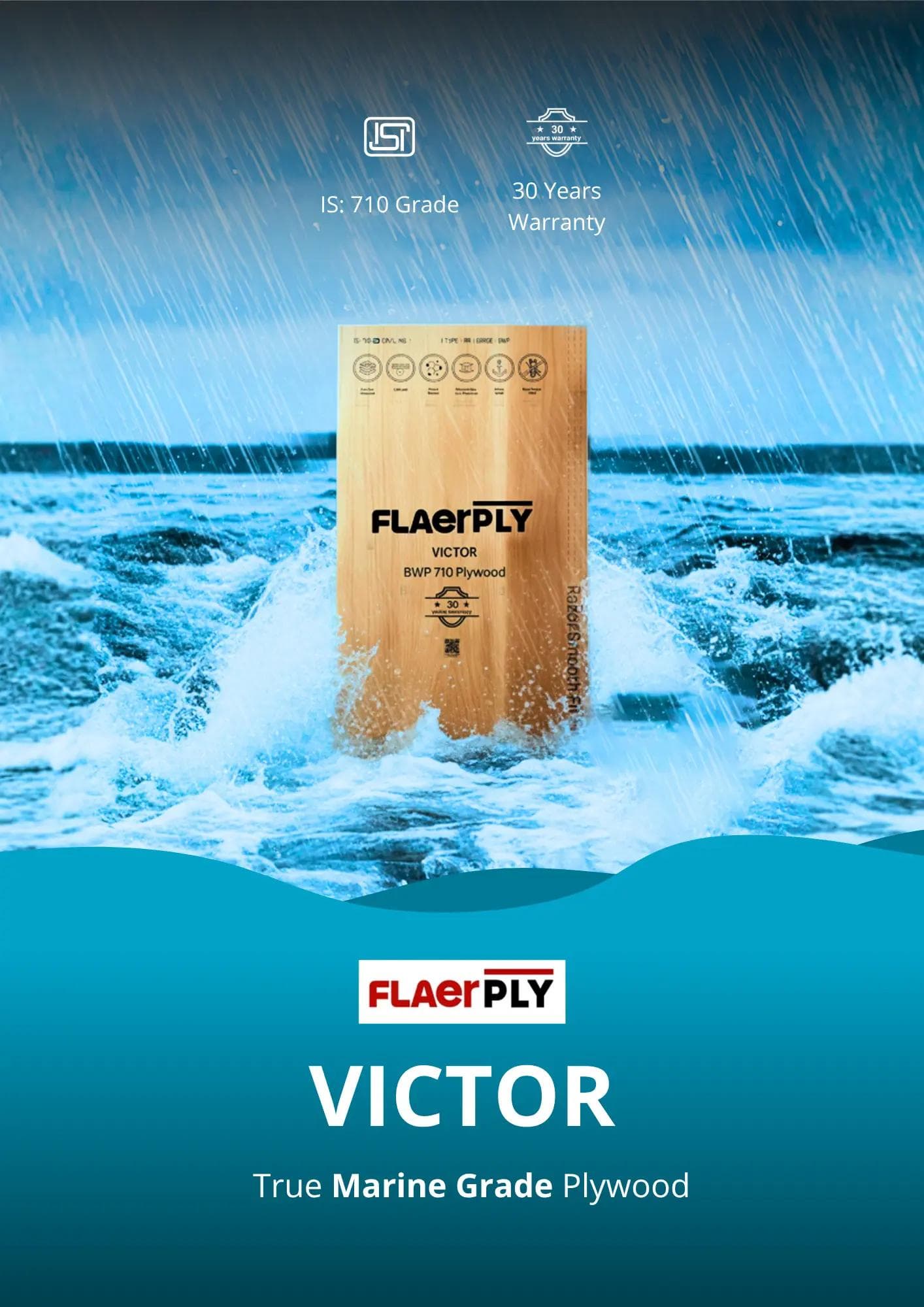
BWP (Boiling Water Proof) plywood is bonded with a phenol-formaldehyde resin — a fundamentally different adhesive chemistry from the urea-formaldehyde used in MR and BWR grades. Phenolic resin bonds don't hydrolyze the same way urea-formaldehyde does, which is why genuine BWP board, manufactured to the IS:710 standard, is required to survive a sustained 72-hour boiling water test without the layers separating.
This is the grade actually designed for standing water and continuous moisture exposure — modular kitchen cabinets near the sink, bathroom vanities, exterior-facing panels, and furniture in balconies or utility areas that see rain. If a space genuinely needs to handle water sitting on or against the board for extended periods, BWP is the grade built for that job.
Here's the caveat that matters even with a genuinely BWP-grade board: waterproofing the adhesive bond doesn't waterproof an unsealed edge. Every plywood panel has cut edges — where it's been sized to fit a cabinet or shutter — and if those edges are left bare, water can still find its way in through capillary action, wicking slowly between the exposed layer ends even though the resin bond itself hasn't failed. This is why a correctly installed BWP panel is always edge-banded, laminated, or painted along every cut edge, not just sealed on the visible faces. A BWP board with a neglected raw edge sitting in standing water for long enough can still take in moisture — not because the grade failed, but because the installation skipped a step the grade depends on.
How to actually match the grade to the room
Rather than defaulting to the highest grade everywhere — which adds cost without adding benefit in a dry room — it helps to match the grade to what that specific space actually experiences:
Bedrooms, living rooms, study rooms — MR grade is appropriate. These spaces don't see standing water, and MR's urea-formaldehyde bond is built precisely for this kind of everyday, low-moisture use.
Modular kitchens — this is a mixed case, not a single answer. Cabinets directly under the sink, where leaks and splashes are a real possibility, call for BWP. Overhead cabinets and shutters away from the sink, which see humidity but rarely direct water, can reasonably use BWR.
Bathrooms and balconies — BWP is the right call here without much debate, since these are the spaces most likely to see standing water, splashing, or direct rain exposure over the panel's lifetime.
Why getting this match right actually matters
Over-specifying BWP everywhere isn't wrong, exactly — it just means paying for water resistance a dry bedroom wardrobe will never use. Under-specifying MR under a kitchen sink is the costlier mistake, because it sets up a near-certain delamination failure within a few years, not a hypothetical one.
The honest answer to "is plywood waterproof" is: it depends which grade you're holding, and whether its edges were sealed properly when it was installed. MR is built for dry interiors and makes no claim beyond that. BWR tolerates short, occasional moisture. BWP is engineered for sustained water exposure — but only delivers on that if every cut edge is sealed, not just the faces.
A quick way to check before you commit to a grade
Since the grade stamp determines everything above, it's worth confirming it rather than taking a carpenter's or supplier's word for it:
Check the stamp on the board itself, not just on the invoice or packaging — a genuine BWP board carries an IS:710 mark directly on the panel.
Ask what the edges will be finished with before installation, especially for kitchen and bathroom units — a edge-banding or laminate step that gets skipped to save time is where most "waterproof" boards actually fail later.
If in doubt, request a small sample and leave a corner submerged in a bowl of water overnight. A genuine BWP sample will show no separation at the layers the next morning; an MR or BWR sample, even a good one, will typically show early softening or lifting at the exposed edge.
This isn't a replacement for buying from a manufacturer whose grading you can already trust — but it's a fast, practical gut-check before a panel goes into a space you can't easily inspect again once it's installed.
Conclusion
Plywood's water resistance isn't a single yes-or-no property — it's a direct result of which adhesive bonds its layers, tested against how much water that space will actually see. Match MR to dry rooms, BWR to kitchen areas with occasional splashing, and BWP to anywhere water can realistically stand or pool, and seal every edge regardless of grade.
Not sure which grade a specific area in your home needs? WhatsApp us a photo of the space — the cabinet, shutter, or panel you're planning — at 800 800 8114, and we'll help you confirm the right grade and the edge-finishing it needs before it goes in.
Related Articles
Masterclass
What Is the Difference Between Flush Door and Blockboard? — FlaerPly Masterclass
Read articleMasterclass
What Is the Difference Between Gurjan Plywood and BWP Plywood? — FlaerPly Masterclass
Read articleMasterclass